Sunday, 18 October 2015

Knaresborough & A World Heritage Site Pt. II


An Autumn vista from the secret view, looking towards the Abbey.

A 20 minute drive through undulating country lanes, scarcely wide enough for two cars, brought us to the entrance and visitors centre of Studley Royal Gardens and Fountains Abbey from Knaresborough. Thankfully the park is well signposted near enough the entire way from Knaresborough, as modern technology in the form of internet signal once again proved that it's not quite as reliable as a good old paper map. North Yorkshire may also potentially be a black hole to the advances of GPS signals. After driving over the dipping blind spots and sharp turns of the countryside roads, giving us the same butterflies that you get from a modern day rollercoaster, we entered the gated grounds of Studley Royal Water Gardens, one of UNESCO's 1031 listed World Heritage sites. The park is preserved and maintained by a combination of UNESCO, National Trust and English Heritage, all of which made our visit very memorable.

The bell tower of Foundations Abbey from the dreaded sheep field.


The extensive ruins of Fountains Abbey.
The visitors centre is made up of a cafe, information desk, toilet facilities and a large shop, selling National Trust merchandise and local produce, as is the norm at these kinds of attractions. Entering through the grounds, you take a pleasant stroll through countryside fields and wooded footpaths. When I was younger I used to hike in the Peak District National Park and one of my most memorable days, not for the right reasons, was getting charged by a ram so it's fair to say I am not their biggest fan. Unfortunately for me, my dad mentioned this to Lidya and her family, so I seem to be the brunt of a long and tedious (for me anyway) ongoing joke. Therefore I had little to no sympathy for Lidya when we walked through a field, on our way to Fountains Abbey, of a large herd of grazing sheep. Now these sheep were the most dormant of livestock, munching away on the grass, but it didn't stop Lidya squeezing and cutting the circulation in my arm whenever one raised its head in our general direction. Coupled with the fact that being brought up in Jakarta, Indonesia, she's unused to pheasants and their often hectic movements, she was very wary of all these hugely 'menacing' animals around us. After recovering her composure we walked along the footpath, the ruinous bell tower of the abbey towering above the trees in front of us, silhouetted against the darkening Autumn sky above us, the aura complete by the cawing of black ravens swarming around the abandoned steeple. Having meandered around a bend through the wooded lane, the extensive grounds of the abbey opened up in front of us forming a vast foundation of what was clearly a magnificent church in its heyday. The grand arches still stood over the entrances, a labyrinth of passageways and corridors jinked through the ancient masonry. Arriving at the western church arch you stand in awe as you grasp the size of the cathedral, still imposing despite being the the grand old age of 800. When considering that this was built all those centuries ago it makes it even harder to comprehend how much of an astonishing accomplishment of architecture this is, coupled with the fact that it's in the middle of nowhere! To the right of the church at the western
Vaulted Cellarium.
doorway is the cellarium, a 100m long vaulted cavern, spine tingling in the day and goodness knows what at night. The one defining feature of any cathedral is the bell tower and until we stood immediately in its presence we didn't quite appreciate the shear size of this one. Despite being a hollow shell, the roofs of the major of the Abbey buildings have since fallen in, the enormity of the cavity still made a resounding echo as Lidya tested with great effect. The arched doorway alone must
have exceeded 10 metres in height. We spent at least half an hour just winding around the rocky outcrops of foundations visualising what and where everything used to be in its glory days. One of the striking features of the smaller buildings attached to the abbey was the refectory where the monks would eat and socialise. Protruding through the ceiling was a chimney, clearly where the large stove had been as there was a large squared out crevice in the side of the wall. I attempted to take a photo looking from the fire place up through the chimney chute, as the National Trust Instagram challenge was to shoot 'Looking Up', but the local ravens had different ideas, perched on the top it decided it would have a poo, fortunately missing me by inches. I took that as a sign that I shouldn't be entering the photography contest!

The bell tower.

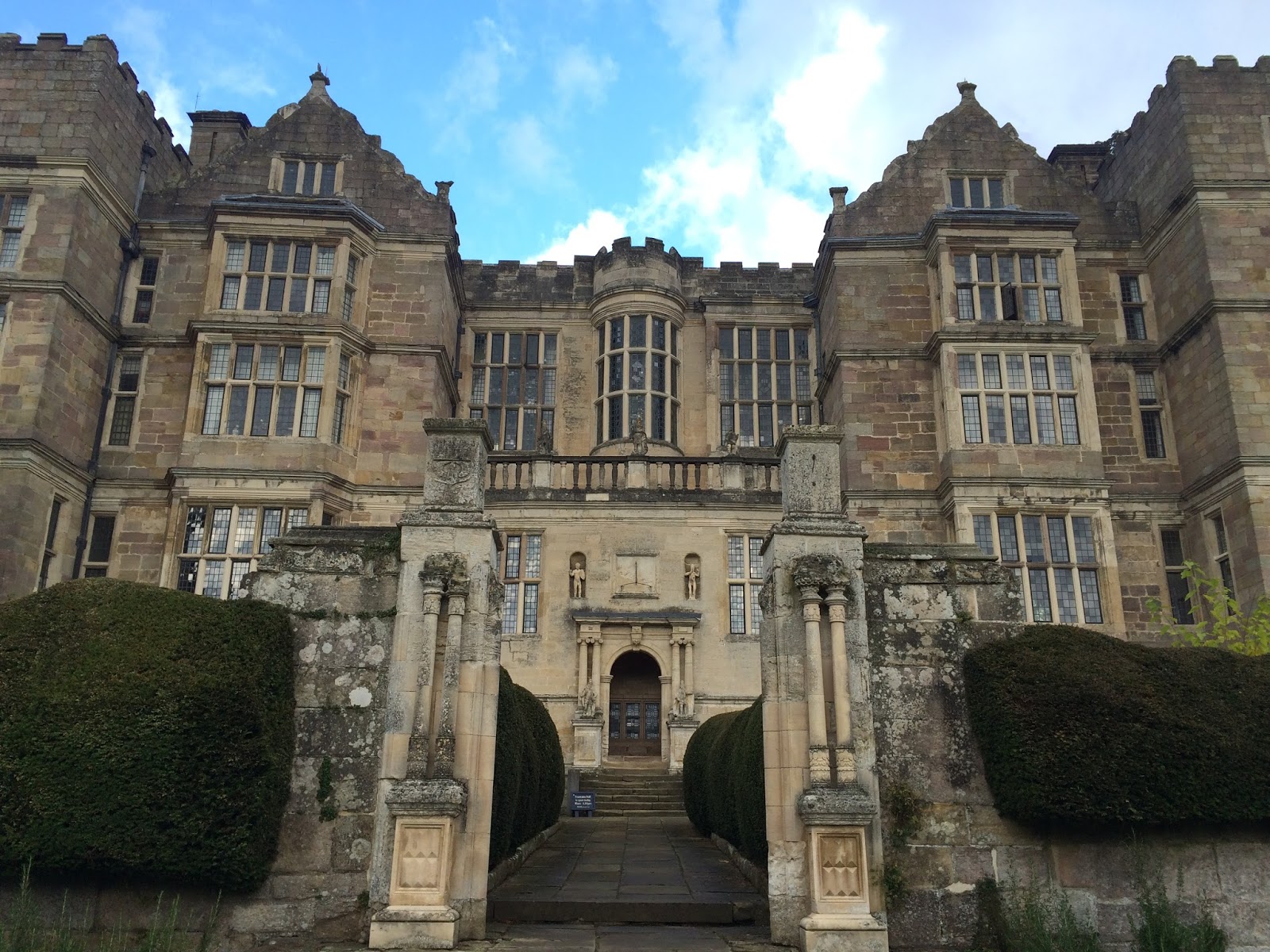
After wandering around the ruins we had a walk through Studley Royal Park, an eighteenth century landscaped water garden, complete with Romanesque mausoleums and columned temples. To the west of the abbey is Fountains Hall, a Victorian era period house, built partially from the stones of the collapsed abbey. Although we didn't walk around the house, the grand facades, sculptures and prettily trimmed and maintained gardens add a charming and very much still living aspect to the area.
The facade of Fountains Hall, a Victorian era house.
This section of the grounds has a cafe and information centre for all the details about the life and times of the Abbey. As we visited in Autumn, the trees were just starting to changed hues and go through the brilliantly vibrant process of shedding leaves, the old stone built bridge over the passing stream complimented superbly with the splashes of orange and yellow of the oak trees.
We strolled along the sculptured valley bottom to the east of the abbey, passed a collage of colour and shapes as the foliage of the range of common and more peculiar trees mingled together. We walked the forested path, above the water ponds, snaking along a path with little surprises at each turn: Anne Boleyn's seat, named after a headless statue which was situated here more than 300 years ago, has a glorious view over the lake towards the abbey in the distance (top photo), only marred by the digger employed in maintenance work; the temple of fame, a columned domed structure featuring a giant sculptured birds nest with a cracked egg shell; the octagon tower, pretty self explanatory, with a hall of mirrors inside and a balcony overlooking the water gardens below; and the serpentine tunnel, a pitch black bricked tunnel, complete with freakishly placed doorways throughout to scare even the hardened soul. Why? I have no idea! All I know is the light on my phone did little to illuminate the passageway, it only enhanced the mysterious doorways and portrayed odd looking shadows on the way. Remember the 
The Octagon Tower.
circulation being cut off in my arm because of the terrifying sheep? Well if it had all but returned to normal it was about to be stopped for a second time!
Having survived the tunnel we succeeding in making it to coffee shop number II, after passing the water garden over a small wooden bridge. Here you can enjoy a tea, soup and slice of cake enjoying the picturesque lake and water sculptures. The distance between the Abbey and the cafe is around a mile and a further mile brings you full circle back to the visitors centre so it concludes a good walk. The last stretch of the grounds is through a 'deer' park. I could sense a third and final loss of blood circulation to my right arm but having tiptoed apprehensively to the peak of the field we saw no deer. I had no i-deer (dad joke) where they were! (I apologies profusely for that). The last highlight of day was the church of St. Mary, an 1870's church, exquisitely decorated with stain glass and marbled stonework, plus a beautiful organ. Even though it's not as awe inspiring as the ruins of Fountains Abbey, let's hope that St. Mary's is better preserved in its current state that the state the grand abbey finds its self in today.


The Facts

Studley Royal Gardens is according to UNESCO one of the finest examples of 18th century landscaped gardens to survive it close to its original form, having influence all over Europe. It was the owner of Studley Royal, John Aislabie, who transformed the grounds into their current state back in the early to mid 1700's. The Abbey began life after 1132 when defected monks from York started to build their own at its current location. The abbey today is the largest medieval ruins in the whole of the U.K.. St. Mary's church is claimed to be the masterpiece of English Victorian architect William Burges. For any further information check out the websites of either English Heritage, National Trust or UNESCO.

Ratings

The Abbey - 5
Studley Royal Gardens - 3
St. Mary's Church - 3
Fountains Hall - (didn't visit)


St. Mary's Church.

Thursday, 15 October 2015

Knaresborough and a World Heritage Site Pt. I


With the world focusing on UNESCO's Palmyra ruins in Syria, we heading an hour up the M1 into North Yorkshire, England, on a day trip to the market town of Knaresborough and Fountains Abbey & Studley Royal Park, a considerably safer World Heritage site. The site was the fourth of UNESCO's list I have visited in the U.K., following Durham Cathedral, the Tower of London and Westminster Abbey. We started the day however with a trip to the photogenic town of Knaresborough.

Knaresborough viaduct as viewed from Marigold's riverside cafe.

   Yorkshire, being England's largest and, of course, most beautiful county, has a diverse array of towns and villages, each with a unique history and its own claim to fame. Knaresborough, a little over an hour north of us in Sheffield, stands out from the rest due to its geographical position on the River Nidd, its houses clinging to the northern valley face, forested to the south and set apart by the nineteenth century railway viaduct whichstill in use today. We began the day trying to figure out how to use our new waffle maker but since we'd woke up later than intended and it came with a bible thick manual we ditched the idea and set off. We parked at the end of the valley, by Mother Shipton's Cave, England's so called oldest tourist attraction, and walked along the riverside. Although we didn't enter the cave it's a very popular visitors spot, famous as the dwelling place of local crackpot (or described more kindly by their website as 'Prophetess') and her ability to foretell the future during the reign of King Henry VII in the sixteenth century. She also predicted doomsday when the bridge, crossing the Nidd between the cave and the pub, aptly name World's End, collapses three times. No need to start panicking just yet though, it's only fallen once and it looked in excellent condition on Monday! Walking along the northern gorge bottom towards the viaduct you can see the towns mishmash of housing styles, some  Elizabethan (the black and white timber beams), some brick built and more curiously, a style I haven't encountered in other places, a black and white chessboard patterned exterior. Down at the waters edge are bed and breakfast's,  cafes and boat hire stalls, embracing the tranquility this part of the river holds. We breakfasted in Marigold's at 10, left hungry by a frustrating waffle iron, overlooking a peaceful Monday morning stream. It's worth noting that the food here was lovely and fairly priced, since cafes and restaurants seem to charge extra for a view. We drank tea and ate scones next to Rosemary, Charlotte and  Anna, little wooden paddling boats, tethered up to the waters edge. Across on the other bank is a meandering path through the autumnal trees of Knaresborough forest.


The ruins of Knaresborough Castle.
Opposite Marigold's in a steep path that winds up the hill to Knaresborough castle. The view gets more picturesque with every stride taken, as the changing leaves add a warming tint to the valley sides, framing the viaduct across the Nidd. The ruinous state of the towns fortifications stands overlooking the gorge, stood like a sentinel on watch. The keeps crumbling remains and castle museum were unfortunately closed for maintenance during our day trip so we missed the opportunity to see the spectacle that previous occupants would have enjoyed. We did see an old lavatory chute which the castle's inhabitants would have used, exiting near it's foundations, so that's something! The castle grounds were peaceful, well kept and free to roam around, currently and historically part of the royal crown, in possession of the Duchy of Lancaster at present. King John, made famous in connection with the writing of the Magna Carta, is supposed to have spent more money on both Knaresborough and Scarborough castles, the destination of our trip last week, than any others in the whole country (See, I told you Yorkshire was the best county!). It's not hard to see why given their stunning location and panoramic views, he was obviously a fan of gazing out of his window. Heading into the town centre is a short walk of a few hundred yards, through brick and stone uneven terraces, taken up in the modern era by trading and antiques stores, art shops, tearooms and butchers. Aside from the checkered facade designs on some of the buildings there were a fair few 'false' doorways and windows that had been painted to incorporate a scene: one being of an Italian style restaurant with a table for two in a courtyard. It's this sort of singularity that makes Knaresborough different from the next market town.


The unique checkered design of some of the towns buildings. 


The false painted doorways and window frames.
 If you've read any of our previous blog entries about day trips in England I'm sure you're aware that they always include a good old fashioned tea room and today was no exception. Situated in the main square opposite the Town Hall, Lavender Tea Rooms, a Trip Advisor winner from 2014, sits above Ye Oldest Chymist Shoppe In England. It's no wonder non natives struggle with our language when we still embrace our ancient vernacular and written word. The inviting exterior of blackened timber and white framed windows gave the appearance of an old worldly time when this style of architecture was common, only made less enticing by the fact that you could choose between this or the much newer 'Wine Shop' next door. If I hadn't have driven then alcohol may well have won the day! Established in 1720, or so the signage reads, it exudes character and if it wasn't for the more recent products displayed on the shelves, you'd be none the wiser knowing if it had changed at all since its foundation. What it was, was simply a little shop of Yorkshire, selling local preserves, sweets, biscuits, cakes, comedic remedies to peoples most common complaints (Man Flu, although this is a genuinely excruciating condition, moody teenager syndrome etc) and ceramics. They even had a bottle of Henderson's Relish, God's favoured condiment choice, which is rarely seen outside its hometown of Sheffield, nevermind South Yorkshire. Upstairs through a creaky low ceiling (WATCH YOUR HEAD) staircase we entered the Lavendar Tearooms, the walls lavished with paintings and trinkets of eras gone by, the black timber frames revealed upon the roof. The thing I like about Georgian architecture is that it seems like there is no planning involved, the only thing that is instructed to the builders is what kind of building is required. Construct a two storied shop between these two buildings? Ok, we'll start with timber. Oh, we've run out of timber? Nevermind, we'll call this the ceiling then and make the rest out of brick. More timber's arrived? Ok, we'll make the roof of wooden beams. I think we've forgot the staircase! Nevermind, we'll fit it in between there, you'll just have to crouch down to enter and duck out of the way of the wooden timbers. In a nutshell, that's about all I can imagine when I study the layout of such floorplans. The outside looks just as haphazard as well. Fortunately, the food and service wasn't as peculiar as the design of the rooms, although the choice of soups (Pear & Parsnip, Tomato and Orange) did raise a few eyebrows. As it was, I opted for the pear and parsnip soup as it sounded bizarre but turned out to be intriguingly sweet and hearty, perfect for Autumn, Lidya opting for the just as flavoursome tomato and lentil. I very much enjoy the shop and tearooms combined and think they are worthy of a visit whenever in Knaresborough.


A little off the road square.


We went to Knaresborough knowing we were fitting in two destinations in one day trip. I think this proved to be the correct choice as 3 hours after our arrival we had pretty much seen what we wanted. Other than the cave and a few nature walks there's not a massive array to do within walking distance. Knaresborough is a pleasant little town, great photogenically and easy to get to but just isn't so fulfilling for a full day. For a full day of exploring, visiting nearby Harrogate or head to where we did (in part II), Studley Royal Park.

To Do

- Walk along the river Nidd to the Castle - Only about 500 yards from Mother Shipton's Cave to the castle but a steep path to the top. The views make it worth it.
- Lavender Tearooms - Fairly priced (homemade soup with thick cut bread was only £3) combined with the shop downstairs takes you back centuries to ye old England.
- Mother Shiptons Cave - I can't add anything from a personal point of view as we didn't visit but it's highly popular so can't be bad! £6 for adults.

The Facts

Without doubt, the viaduct is the most photographed of all Knaresborough's landmarks. Construct finished in 1851. The current castle was established in the fourteenth century despite being pre-dated by earlier fortifications as alluded to by its old name 'Chednaresburg' (Burg meaning defensive structure).

For any other information about Knaresborough feel free to look at the official town website - www.knaresborough.co.uk

Ratings

Knaresborough - 3
Castle - 2
Lavender Tearooms and shop - 4
Views - 4
Marigold's - 3
View of the River Nidd and the viaduct from Knaresborough
Castle.


Thursday, 8 October 2015

Scarborough: A day trip to the Yorkshire Coast


To any young child from Yorkshire, Scarborough was the ultimate day trip. It was all flashing lights, 2 pence slot machines and candy floss, a kids version of Las Vegas minus the sleaze and sin. I used to save up copper coins year round in a tin anticipating the road trip to the seaside to play on the Pacman machine, the horse racing and the overly frustrating claw that all dads seem to think they are master of. I was half expecting to dislike my return to Scarborough, what we like as children never quite seems to emulate the feeling of when we've matured, but it had much more to offer besides the gaming arcades that caught my attention 15 years ago.


Lobster traps along the harbour wall with the grand Scarborough hotel in the
background.


We visited the Yorkshire town on a Monday, very different from a Summer's weekend when everyone seems to have had the same idea to spend their time in the very limited English sun by the sea. The air was calm and the temperature mild, seafront road like a quiet country lane, the only activity being the local fisherman drinking their morning cups of coffee and yakking beside a small breakfast stall next to the sea wall. The stench along the harbour was a combination of freshly caught fish and sea salt, almost burning the inside of our nostrils from the potency, the culprit of which was the recently used lobster traps pilled up along the dockside. At this point Lidya was debating whether or not a human could get trapped in the meshed netting but after a few minutes of laughing/arguing we agreed upon the fact that we'd probably have drowned had it been us, deservedly so if we'd managed to get fooled by a lobster net! Although I may struggle to portray Lidya's mind frame in writing, a moment never stays dull for long as she ponders yet another utterly bizarre circumstance. Scarborough is split into two bays, the South being the more active touristic beach with the shops and amusements, the North being much quieter with a handful of restaurants and the aquarium at the very northern point. The bays are separated by a natural headland on which sits the towns ancient castle (which I shall walk through later), one of Scarborough's most iconic buildings along with its famous hotel, the Grand Hotel. Rising above the bay, the Victorian styled B&B looks much like the Grand Budapest Hotel, it oozes character from its facade and I'm hoping its charm is completed by a totally incompetent concierge and mischievous bellboy!

A local pub. It seemed massively out of place
among the arcades.
After losing half a years 2 pence savings (3.20GBP) on slot machines and only a troll key chain to show for our efforts we heading off the beaten track towards the town through a terraced alleyway to a road behind the sea front. We wandered along and was pleasantly surprised to see a aura much more associated with an old English market town; independent shops selling everything from devilishly indulgent homemade fudge to a toy store of train sets, old matchbox cars and scalextric. If only I was 7 or there was a small child fit to steal for the duration of my nostalgia trip.
The heart of any English countryside town or village is the market and although the inside may have seen a more thriving time, the outside certainly matches Scarborough's hodgepodge streets. Brick build, with arched windows, it looks the part of a nineteenth century mill and I can't image its appearance has change much, if at all, since then. The inside didn't really live up to expectation, whether that was because we visited on a Monday morning or the fact that Tesco's is just more convenient. There was only a handful of stalls, albeit with delicious looking fresh fruit and veg and some quality butchers. Downstairs though, in the vaults, something that looks like a possible setting for SAW XXIVX or whichever number they're currently filming, was a different story. It had charm, character, potentially poltergeists, all hidden away in like cavities between the vaulted low ceiling. There was an artists shop, old fashioned toy store, second hand bookshop, even a very peculiar doll store whose merchandise looked suspiciously the work of someone who practices voodooism. There was even a cafe downstairs that was packed, no doubt a locals favourite.


Scarborough's South Beach from the castle walls.


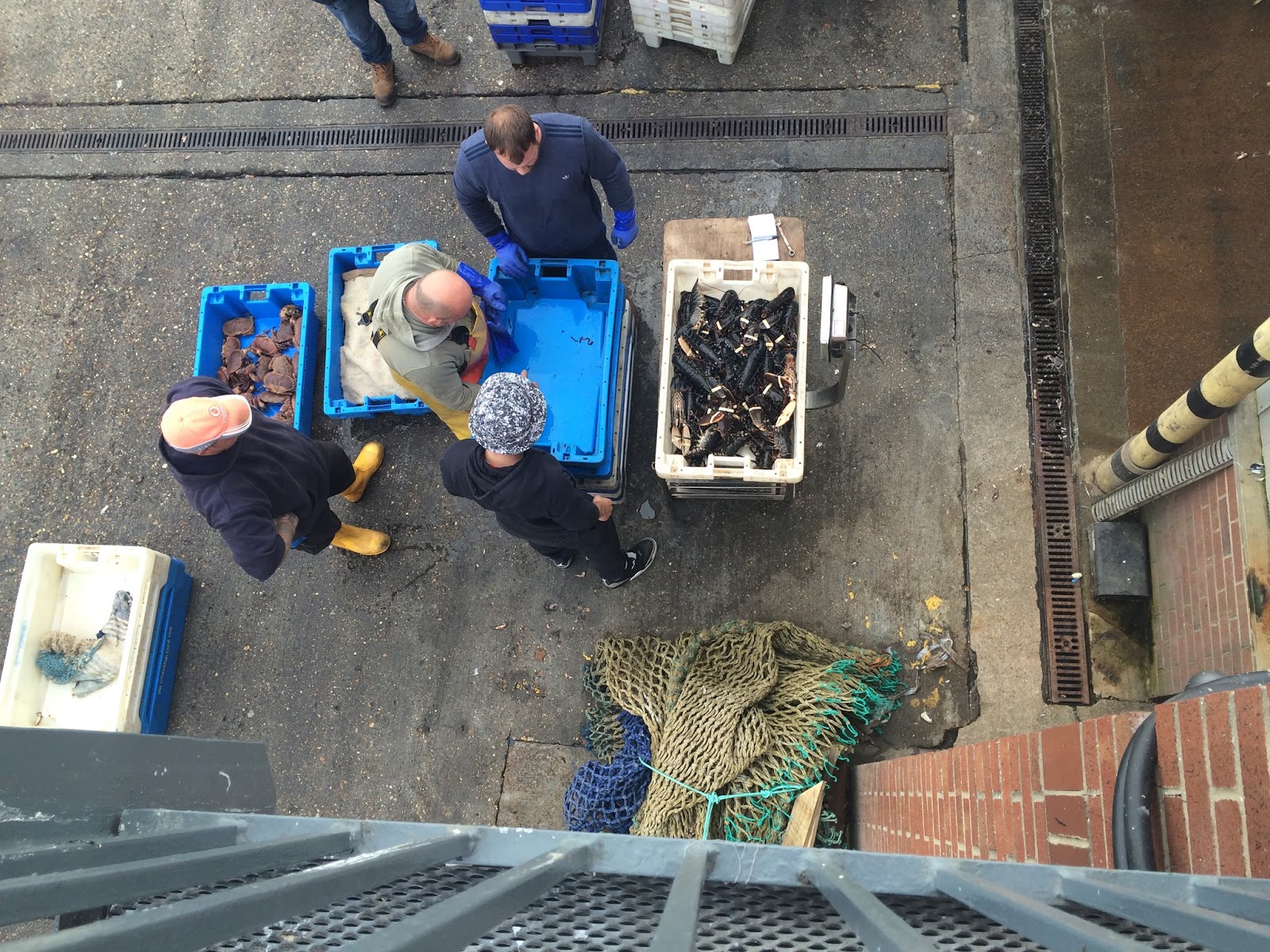
On the balcony at the Harbour View Cafe. Fisherman sort through
the lobsters and crabs they've just hauled in.
Since we were by the seaside in not so sunny England, it would be almost an insult to this great land not to dine on one of our most celebrated dishes, fish and chips. It wasn't quite midday so we had a cuppa tea in Cafe View, a quaint eatery whose mouthwatering cakes on display in the window enticed us in. The bay window faced the sea, the strip much busier now than previous and the seagulls out in force. Lidya had taken to searching TripAdvisor whilst sipping her Yorkshire Tea for the towns best chippie. Having found one, she searched the address and with a puzzling look on her face was preoccupied with her phone for a good 5 minutes. After passing me her phone and claiming it was shut down it took me all of 2 seconds to realise it was open. 50 metres away. Straight in front of us out the window! I used to study geography in a mixed sex class and all students were excellent map readers so in no way am I sexiest but Lidya did embrace the stereotype based on women reading maps! After finishing up in the cafe, which was very lovely, friendly and served a very refreshing cuppa, we headed to Harbour View Cafe on the West Pier, jutting out into the ebbing tide. Imaging, strolling along a pier, the days catch, lobsters, crab, North Sea cod all being brought into the dockside warehouses, the salty sea air icy crisp from the preservation boxes, all whilst walking to eat fish and chips. Now that's something a city street chippie can't buy! I did mention the overpowering smells when I walked in, just as a conversation starter, to which the staff showed concern and eagerly went to investigate but it turns out my nose is more acclimatised to my works coolant and oil as oppose to the fresh sea breeze these fisherman are born and raised with. I have to admit, the cafe lived up to the build up and to TripAdvisor's outstanding ratings. Melt in the mouth, battered crispy haddock, beautiful mushing peas and chunky chips, all without the excess grease that lets so many chippies down. It even had a balcony in which to enjoy the view but be warned, the seagulls don't take kindly to strangers, especially when you have chips!


View of the bay from Harbour View Cafe. The castle overlooks the town.

Headland Red from Wold Top Brewery.
It took at least half an hour to persuade Lidya that walking up the hill to Scarborough Castle would be worth the effort. Although she took a rest break at regular intervals (every bench we passed at about 100 metres apart) and huffed, puffed and complained more than the characters in the recent Everest film we made it to the front gatehouse to find a paved path and road from the opposite side of the hill right up to the entrance. If ever there was a 'Are you kidding me!?' look then it was definitely plastered all over Lidya's face. As members of English Heritage we visit a lot of castles and one of the essential characteristics for us is its setting and views. The castle's occupiers of the past, regardless of whatever hardships they may have suffered, must have been eased by that spectacular landscape. You can see for miles! To the south you can see the bay we'd previously wandered around and the main town of Scarborough, Filey further down the coast, all the way to the prehistoric Flamborough Head Heritage Coastline, England's fossil hunting grounds. To the north the vista stretches out revealing the aquarium at the far end of the northern bay, surpassed by the undulating shoreline towards Robin Hood's Bay.
The keep is in a ruinous state but possibly adds to the charm, a reminder of days gone by when it used to keep a watchful eye over the historic bay. We even encountered and shared poses with a lovely elderly Italian couple who'd ventured up. There is half a keep left, a narrow gatehouse, several walls still very much intact at the inland Western side, foundations and remains of buildings of passed fortress dwellers and a moat. The wall snakes down the hillside to the gatehouse, offering a daunting passageway for any would be invaders. Add to that a much more modern cafe, free wine tasting and a brilliant selection of locally brewed beer from the Wold Top Brewery, it makes for an ideal picnic spot on the extensive grounds.


View from Scarborough Castle walls towards the Northern bay.

 Scarborough is definitely a seaside town that I remember as a kid and one that I was hesitant to revisit as an adult but Lidya and myself both really enjoyed it and would recommend a day trip there if the opportunity arises. It has a good range of activities from everyone; arcades, historical sights, walks along the coastline, plenty of cafes and decent shopping.

To Do

- The Castle - 5.20 GBP for adults and 3.10 GBP for children
- Harbour View Cafe - Best fish and chips around and with, unsurprisingly, a harbour view! I think it was about 14 GBP for 2 very large meals.

The Facts

The castle is the iconic centerpiece to Scarborough's 'cityscape'. It has been occupied for around 3,000 years as its geography makes it the ideal fortress. Although it has seen better days, it's remains have seen much royalty and battles, including the English Civil War. The keep was built in 1138 by William Le Gros. The town holds claim to be the first British seaside resort, ever since the seventeenth century and remains one of the busiest in the UK. The Grand Hotel was built in 1863 and is one of 'The Seven Wonders of the English Seaside' according to Historic England. Yep, apparently that's a thing!

Ratings

(Ratings out of 5)

Scarborough - 3
Castle - 4
Harbour View Cafe - 4
Market - 2


The remains of Scarborough castle keep, overlooking the North Sea.


Thursday, 1 October 2015

It's The Time For Coffee


ALOHA!


First thing first, apologies for this delayed post due to me being poorly. Now that i feel better, hopefully i can finish this post in one day.

Half of this post was written around two weeks ago. and half of this post is written (hopefully) on the day you read this post. Which is first of October. OH! how can i not believe that we are getting closer to the end of 2015. It was just couple days ago i wear nice blue dress bought by Richy in Chester for the new year eve party.

Well then.....
Today, moi, yours truly, will be reviewing something exciting. It is about the quirky little coffee shop that has only just opened for 2 weeks now.

Situated in the middle of Sheffield, coffee shop that have a catchy name to remember, Coffee o'Clock. Depends on how you see it, the name is actually shows you how unique this coffee shop is. So, for me, it's either "you want to spend some hours in the coffee shop" or "it's always a coffee time in the coffee shop." Cheesy!

Well, without further yapping, let's review!

I've sat for around 2 hours in Coffee o'Clock, making a note of what i want to write in this post about the brand new coffee shop. I wasn't really sure of whereabout is this coffee shop as i'm not to familiar with London Road. But is quite easy to find the shop. I'll write down the address details on the bottom of this post.

So, Coffee o'Clock. First time i came into the shop, i can see a great idea of concept. Idea. I wasn't too ecstatic, to be fair. When my husband tells me about the coffee shop in London Road, i wasn't really interested to even listen to it. As you probably know, if you live in Sheffield, London Road is known as an international row of restaurants, bars, pubs. It's a heaven for those who like to change in their dinner menus. But coffee shop? Not so much. The whole journey looking for the coffee shop, CMIIW, i only seen one other coffee shop. Not too sure what the name is, but i can't even tell you if i'm sure that i see the door for that other coffee shop. LOL.

Back to Coffee o'Clock, first surprise they gave me was, the owners are Asians. Hey, i did NOT see that coming! i thought it would be just another British coffee shop. But nope, i think i should not judge before seeing it myself. The owners are from China, ladies and gentlemen. I didn't ask their age, since it's insignificant and rude. But if i'm allowed to guess, they are probably around my age. around 20-30.

One of the things that i regret about the place was i'm not to sure of their concept. It's like a mix between Parisian coffee shop, British coffee shop, and Chinese coffee shop. A little bit confusing. Doesn't mean it don't work.

middle seating area

Chinese traditional tea ceremony area and my head quarter for the night.
The shelf in the middle fulfilled with books and games Mostly in Chinese.

I find it fascinating that they have some Chinese typography on their wall. Made me feel like a samurai for a second. Haha. I have no idea.

Two thumbs up for their hospitality from the first moment you walked in. They did made an incredible efforts to show us that we are welcomed. Not only that, they will also deliver you to your seating table, explain their menus with a smile from ear to ear,  deliver your order to your table, and explain more in depth about the drink you ordered. All you need to do is ask.


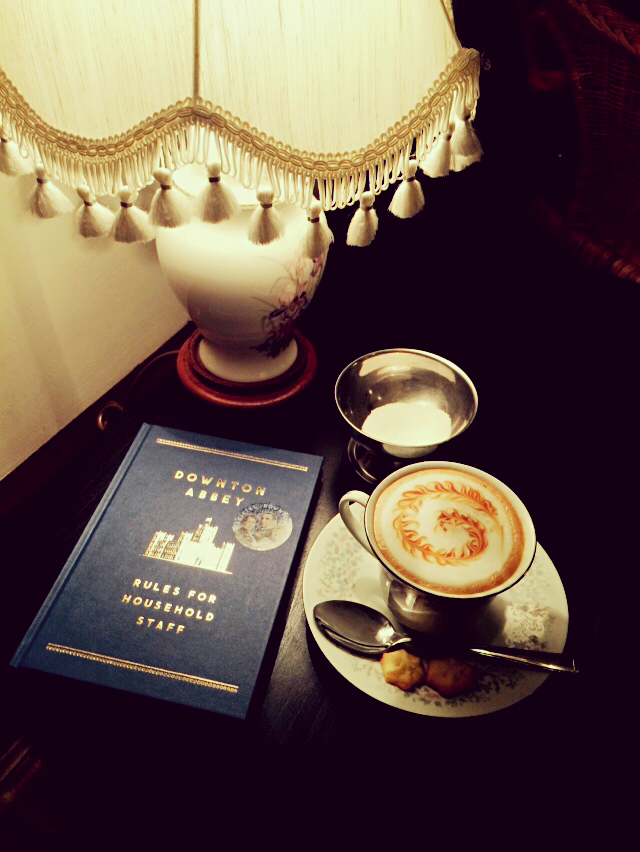
First drink i've ordered was the one that they recommend, Caramel Machiato. It only took them to tell me,"our Caramel Machiato is different from any other Caramel Machiato." for me to order this pretty drink. I gave them that, their Caramel Machiato is, indeed, special. The coffee is strong, bitter sweet with a fruity after taste. But somehow, you still be able to taste the caramel in it. a balance taste of two completely opposite flavour. The owner then explain about why their coffee bean is so good. It's way different from the coffee bean we usually have in some brand chained coffee shop. The secret is by choosing the coffee beans all by himself, and personally airmail them from somewhere in Africa through a relative that lives there. So with only as little as £3.50, you can taste this delightful cup of coffee. Complete with the little tiny cookies to accompany the coffee that somehow actually help your mouth to taste the bursting flavour of the coffee. What's better than a free cookies? A free handmade cookies.

One thing that is bad about this drink, is that you will finish it in a couple sips. took me 3 minutes to finish everything. It's just SO GOOD!

Then i go back to the counter to order my next drink. At that time, Rich was playing football, so he left me there telling me that he's gonna pick me up in 2 hours. So obviously, i need more drink!

Again, i'm quite confused of what to order. They seems to have a massive range of drinks to choose, so i ended up mentioning my blog and ask them to give me the quirkiest drink they have.

Here it is! The mighty green oolong tea. With the help of the owner, i have some explanations about this tea. Apparently, this tea is the most popular tea in China. People there usually drink this tea after a meal. So from there, you know that it's good for your digestion system. But not just that, it's also good for your blood circulation. It helps you prevent the blood from clogging. Just like magic! It also good for detoxication. So ladies, this little thing could help you with your diet. Hehe. With as little as £3.50 per cup or £7.00 for an endless self refill, you can enjoy this cute little thing, not only after your meal, but just anytime you want. I've ordered myself the refill one. Which comes with the brewer, a cup, and a pot of hot water to re-brew your tea leaves. Below this, i will show you how to drink the tea step by step to show you how fancy this drink is. The re-brew-ing process took me around 10-15 seconds. But of course, the more you brew the tea, the longer it took the tea to be completely defused. For the taste of this tea, it has a great fragrance and earthy taste. Very traditional, if i may say. It looks like a proper green tea. So if you ever drink a traditional green tea, you will know what i mean. Overall, it's an easy drink. It clears up your taste buds too! So don't worry, you will not be bored of this drink.

Here's how to drink the Green Oolong Tea.

First: take away the lid part of the brewer

Second: turn the lid upside down, and place it on the table beside the brewer

Third: Pull up the strainer part inside the brewer. Be careful, it's boiling!
Shake the strainer slowly to take away the excess water that stuck in between the leaves.

Fourth: Place the strainer on the upside down lid.

Last but not least, pour the tea into the little shot cup and enjoy the tea!
To re-brew the tea, just put back the strainer, pour more water in, put the lid back on, and wait for 10-15 seconds. Just as easy as that.

If you fancy to see the traditional tea ceremony, you can absolutely do it here! The lady will be so happy to assist you with only £15.00. But you have to give them an early notice before you do it, because the tea has to be prepared earlier.

The only low point for me towards this coffee shop is that i don't smell any coffee brewed in this coffee shop, which probably because they only has been opened for around 2 weeks. For some people, it is not necessary. But for me, it's kind of a selling point since the coffee smell is one of the main builder of the atmosphere of the shop.

The last time i went, they haven't really finished the building of the coffee completely. So there were no toilet for the costumers. My advice for the owner, toilet is very important for coffee shop. Since we expect ourself to hang in there for quite awhile, we will drink a lot! So toilet is quite an essential.

Other than that, two thumbs up for the concept of this coffee shop and the taste of a real coffee that they have. Impressive! I look forward to visit again next time. Hopefully in a near future.

Well that's it for the post today. Hopefully it helps you all Sheffielders to find a new place to hang out!

For the opening time, i specially made a note of them for you:
Monday to Friday: 08:30 - 23:00
Saturday: 09:00 - 23:00 
Sunday: 10:00 - 22:00

If you want to check them up, which i recommend so, you could check them on:
Or their website: http://www.coffeeoclock.co.uk
Their Address at:
254 London Road
Sheffield
South Yorkshire
England
S2 4PA
Telephone: +44 (0) 7759 110 200
Email: Coffeesheffield@gmail.com
Cheers!

Lidya Phipps

Monday, 27 July 2015

Best Tea Room Ever!


Bello Babes!

Ok, so I know this is couple days too late (almost a week, pft.). I got a new job and was kind of busy with that. Sorry!

But here I am with a brand new review!!!

My Husband, Mr Richy, has been so nice to me by taking me to Newark for a day out.
IT WAS FUN! The day we were there was, in fact, a day where the little town is having a vintage market where I found a gift for my older brother's coming up birthday.


So what about this Tea Rooms that is so special?


Me in front of The Old Bakery Tea Rooms, Newark

The tea rooms building is a victorian style building that is -apparently- almost 500 years old.
The first thing you feel when you get into the building was getting into your grandma's house. the smell of scones, teas, coffees, was almost overwhelming.

According to our research, the owner of the tea rooms is Italian. For that point, being so stereotypical, the food they sell are simply magnificent.

Roasted Garlic and Butternut Squash Soup

We are so delighted to see the food in the picture.

When you go to a traditional British tea rooms, they usually have "soup of the day" written somewhere on the board hanging in the tea room.

I myself, really love a good traditional cream soups that often offered in many tea rooms all over the UK.

As always, when I go to a tea room, I ordered their soup of the day that happens to be this unbelievable pretty looking soup. It is roasted garlic combined with butternut squash. It is served with two slices of crusty bread and, of course, butter.

I cannot find any flaw in this soup. The soup was bursting with a gorgeous flavours. It's plated perfectly. I may say, even the butter was in a perfect consistency. The bread was extraordinarily taste great with or without the soup. Each and every spoonful of the soup, I will make a weird noise and then say "oh this is so good!". For me, this soup was the best soup I ever tasted in my life. Never thought a bowl of soup can be that good? You should try it yourself! It is incredible, until the last spoon. I could probably just lick the bowl when I finish the soup, it is that good!


Smoked Salmon Brioche
The next food was smoke salmon brioche. Look how pretty it's presented! The creamy tasting of the cream cheese combined with the smoked salmon that melts in your mouth? It's to die for!

I would give the chef a standing ovations for his work of culinary art! It looks impressive, it tastes amazing. The chef simply brought the old traditional tea rooms to another brilliant level.

The day was great, we sat down outside. while we enjoying the lovely meal, I also had the chance to try their Italian Iced Coffee.

Don't know how my husband managed to find the tea rooms, but I love him even more for this.


Omelette
The picture you see next is an omelette. I forgot exactly what it's called. I can't really make a review about this food because this is Richy's meal.

All that i can say is it taste great too. I had a bite of it, but I was too busy about my salmon to make a detailed review about this food. But really, I doubt that you can find something that they sell here that taste bad.

All food they sell are in a medium range of price. I will make a ratings below this post about every aspect of this tea room. So make sure you read this post until the end.

Let me know if you want to know the detail of price for all the food and drink we had. I will be glad to write them down in the comment for you.


The interior of the cafe was very clean and cozy. a small building looking very classy, makes you want to stay there for a little bit longer.

Overall, i really like this tea rooms. I'm pretty sure that i will be back there in the future.

So glad to find a place just an hour away from our home that actually really great for you, family, and friends to just hang out and have a great meal.

The Cake Bar Inside the Tea Rooms


For you who want to check the place up yourself:
The Old Bakery Tea Rooms
4 Queens Head Court
Newark-on-Trent
Nottinghamshire
NG24 1EL
Phone: 01636 611501
www.oldbakerytearooms.co.uk/

Now for the rating from Twenty Toes UK:
Place: 8.5/10
Food: 9/10
Drink: 8/10
Service: 7/10
Price: 8/10

Now there you go, new review for your hungry tummy!

Make sure you keep checking our blog for the next adventure reviews and stories!


CIAO BELLA!


Lidya
Twenty Toes UK


Saturday, 4 July 2015

Menorca, Spain - A Tale of Two Towns (Part. I)


Menorca, one of the Balearic islands in the Mediterranean Sea, is a popular holiday destination for Brits, Northern Europeans and Spaniards alike. But unlike Mallorca and Ibiza, the more well known of this Spanish group of islands, Menorca is a laid back, much more rural and untouched gem, surviving on its own cultural and natural beauty, away from the mass commercialisation that many of Southern Europe's isles have succumbed to. I remember visiting Menorca as a child, before my teen years with my brother, parents and grandparents and staying in one of the few touristic bays called Cala Galdana on its southern shores. Fifteen years later, older, probably not much wiser, definitely balder but with a greater sense of enthusiasm, passion for exploration and travel, I ventured back, about 7km to the East to the small town of Santo Tomas. Lidya and I had kindly been invited by my parents to share a villa with them and my nan to which I gladly agreed (Free holiday! How can you reject that!?). We spent a week here which, unfortunately for everyone involved, was sadly marred by the passing of two very close family members within 5 days of each other. Although this greatly hindered our enthusiasm we managed to achieve the purpose of what this blog is all about; getting to know a place beyond its usual reputation. For me, Menorca has always been renowned for its beautiful natural coves and its 'floating' boats on the crystal clear waters. As we found out however, Menorca is very much a tale of two towns.

Part 1 - Mao-Mahon (Llevant)

From our base in Santo Tomas, Mao is reachable within 45 minutes on the local buses which operate throughout the week from around 8:30am to 8;30pm at a cost of 3.25 euros each way. Our villa at Santo Tomas was very much central to the island in terms of West to East (it sits on Menorca's southern coast) so it gave us an ideal starting point in which to explore Menorca. The 27km drive passes through the municipalities of Es Migjorn Gran and Alaior, of which I shall revisit in a future post, along the major road, ME1, which dissects the island. The main roads leading into the town of Mao from the west consist of numerous retail shops, factory outlets and small business blocks, the more modern side of the centuries old town. Along with car dealerships there was also a yacht showroom, all of which I assume were well out of my price range. Before entering the traditional part of the islands capital we passed the small football and athletics stadium, home to Menorca and Mahon football clubs.


Expertly drawn map of our route through Mahon.


The bus dropped us off at the towns station where all the islands buses arrive, a 10 minute walk to the harbour and just 5 minutes to a selection of shops and restaurants. The above map marks our twenty toes trail through the old town cobbled streets. As we had caught the earliest bus at 8:35am from Santo Tomas we had decided to eat breakfast in Mahon. Straight outside the bus terminal we found three or four busy cafes; Casa Sexto, El Viejo Cafetin, mostly packed with the chatter of locals who sipped on their morning lattes, cigarette in hand. All the menu's sold very similar selections of tapas and beverages all at a very cheap price comparative to the central hub. We walked to a nearby square named Placa Esplanada and selected Cafe Amadeus (1) as our first port of call, only 200m from the station. One of the meals I love to eat when in a European city is breakfast since nearly every nation on the continent has their own version of a sweet pastry. Although most commonly associated with Menorca's neighbour Mallorca, the ensaimada is on near enough every menu and available in any bakery. Similar in texture to a croissant but looking more like a Danish pastry, it's light, flaky, sweet from the icing sugar and is either served plain or with a filling of chocolate sauce or custard cream. I'm writing this the day after returning from Spain and I'm already starting to have withdrawal symptoms. The cafe itself has a pleasant view over the square as we watched the shop tellers set up for the day ahead in the warm morning sun. Inside was a fully stocked bar and they had a wide variety of dishes ranging from a breakfast selection, tapas and full course meals, no doubt a lively establishment when the sun hits the horizon. The staff were all amiable and helpful and it'll definitely be a cafe I'd enjoy spending a lazy hour or two in the temperate Mediterranean sun.


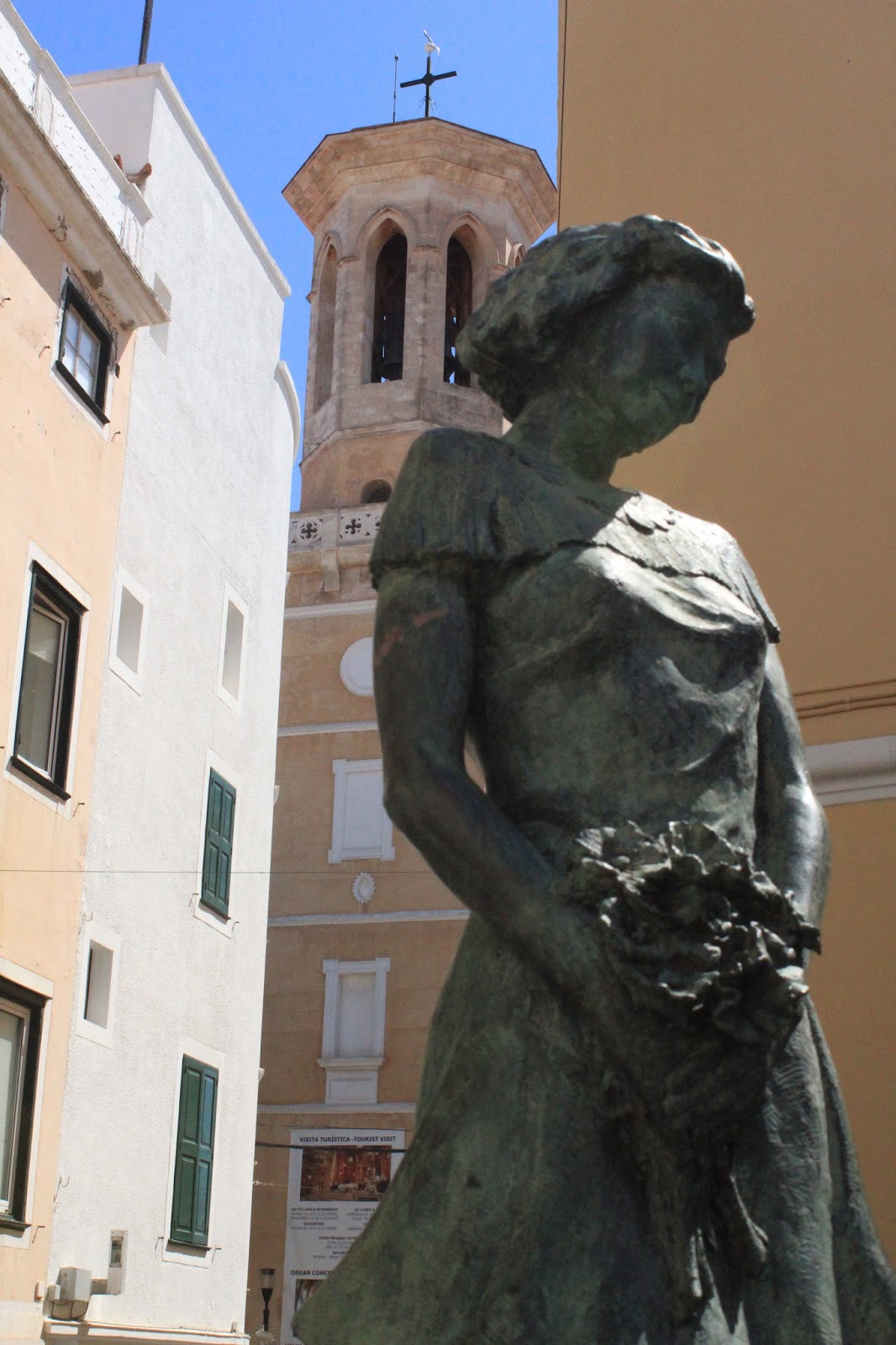
A statue in Plaza Colon in front of Santa
Maria's bell tower.
Walking away from Placa Esplanada, we headed north east towards the centre of Mao, passing through terraced styled Spanish shops and buildings, three or four storeys high with nonuniform verandas and window boxes, jutting out over the streets below. Tables and chairs from half a dozen cafes adorn a broad pathway (2) trailing towards the unconventional streets of central Mahon. At this point, the walkway starts to descend past intermittent shops of modern fashion and traditional bakeries. Another small square, Plaza Colon, provides another pit stop to refill on Menorcan Pomada. Towering over this square is the bell tower of the Cathedral of Santa Maria (Iglesia de Santa Maria) (3). Partly Gothic, partly neo-classical, the church is neither striking in detail nor structure yet stands out purely based on its size among the surrounding buildings. Built from 1748, its most notable feature is its 3210 piped organ. I'm pretty happy I didn't hear it being played as I'd left my ear defenders at work. Located along the Placa Constitucio with the town hall, we found it to be one of Mao's most memorably squares. The town hall, or S'Ajuntament, is definitely the most aesthetically appealing building in this opening, decked with arches, moderately detailed facades and topped by a clock, that was presented to Mahon by Richard Kane, the first of the towns British governors. We walked down a narrow alleyway between the church and the town hall to another common, whilst the crowd followed the main road towards the market. Placa de la Conquesta is nestled between the back of the church of Santa Maria and the houses clinging to the cliff face, vacant, except for a lone statue of Alfonso III, who liberated Menorca from the occupation of the Moorish (North Africa Arab) rulers. The main highlight of this location however is the viewpoint from the cliff face (4), the panorama being of the most inner part of Mahon's large natural habour. From here you can see the winding path that leads down to the dockside, plenty of yachts and villas that climb up the banks of the opposite shore, the old British naval port that is now occupied by the Spanish Navy and an array of seafood restaurants and bars that wind around the inlets bay.


The clock face and archways of the
S'Ajuntament, or town hall.
Stature of King Alfonso III in Placa de la
Conquesta, who evicted the north Africa
 Moors from Mao-Mahon.

The winding road down to the port was a pleasant, tree shaded descent to the waterside cafes, bars and restaurants of Llevant (Llevant, as Mao-Mahon is sometimes referred, means 'East', as oppose to Ciutadella 'Ponent', or 'West'). Although we didn't venture far along the meandering road that mimicked the contours of the waters edge, we had a wander around the few makeshift stalls that sold the typical 'I love 'enter city's name here'' T-shirts and common souvenirs and trinkets before settling at a dockside bar named 'Varadero' (5). Close to midday, the south European sun was bordering on sweltering so the much needed respite came with the opportunity to sample the local Spanish beer, a must in any country. Although Menorca is renowned for its gin as oppose to its beer, I had the choice of three Spanish mainland options; Estrella Galicia of A Coruna, Mahou of Madrid or Estrella Damm of Barcelona. Since the Catalan's had an involvement in the history of the island, I opted for Estrella Damm (it was the cheapest but I am pretending it's due to its possible slight significance). Despite the glorious weather and it being lunchtime, the harbour restaurants and bars were oddly quiet, very strange considering the beautiful setting. Granted seaside establishments tend to be pricier than the rest but the bar we drank in was very reasonably priced, offered great views and the staff were once again attentive and friendly.


View from Varadero's on the harbour.

After our beers we headed back from where we came, through Parc Rochina, this time turning in the opposite direction towards Placa Del Carme. Down at dockside, the two standout features of the town are the two churches, that of Santa Maria and Esglesia Del Carme (6), so having already walked past the former we naturally headed for the latter. Fronted by a statue of three darkened steel horses, the church and adjoining convent, built from 1726 onwards, looks of a different era, much older in my opinion, although as you can see from the information given, they were built around the same time. The styles are very much dissimilar and the Esglesia Del Carme was built outside the original city walls, maybe a reason towards its different characteristics. The church is very much second choice to the treasures to be found in the converted convent. Within the Mercat des Covent (7), or the Convent Market, there is a wonderful array of local fruit and veg, meats, fish, chorizo, cheeses, bakeries, confectionery, clothes and other regional products. It's refreshing to go into a food market and be greeted with vegetables of peculiar size and shape but undoubtedly fresh and delicious, as oppose to the general supermarkets that only select the produce that's 'aesthetically pleasing' on the eye. We bought possible the largest red pepper I've ever seen, a few varieties of different potatoes, garlic cloves, huge aubergines and waxy skinned cucumber. Everything seemed so vibrant and colourful, there was a very refreshing fragrance wafting around the old stone archways of the original church building. Chorizo sausages hung from racks outside the butchers, nothing uniform about their appearance whatsoever, the 'perfect' look very much sacrificed for purely quality produce. We saw irregular grown plums of odd shades, giant deep red cherries that were almost the same size as kiwis, ensaimada's 18 inches in diameter freshly made that day and the pungent draw of Menorcan cheeses, sourced by the islands farmland cultured residents. Although the prices are very reasonable for a farmers market it is easy to get lured in and brainwashed by the luxuriance of what's on offer. Having spent around 15 euros, we came away with enough vegetables to feed a small army.  The makeover of the convent hasn't just brought a local food market, there is a school of music on the first floor along with an art collection and museum detailing the islands past.


The front entrance of Esglesia Del Carme and the convent to the left.

As this was our first venture outside Santo Tomas and it was lunch time, we planned to indulge ourselves with Spain's national dish, with a view! In the north western corner of the convent is a bar/restaurant called Cafe Sa Placa, with quaint views over the inner most harbour and the western portion of the town. The terrace outside was well shaded with umbrellas to keep us out of the midday sun and we were kindly aided with a new brolly as ours had broken. No matter where you are in the world, a great vista and a cold pint of lager is always one of life's little luxuries. It sure does help when it comes with a large pan baked, sizzling hot traditional Spanish chicken paella. We ate paella 4 times whilst in Menorca, once here, once in Ciutadella and twice in Santo Tomas but this one was definitely our favourite. It was the brightest of yellows, like a reflection of the Mediterranean sun, mixed with juicy chicken on the bone that melted on contact with our tongue, red and green peppers plus giant beans all of which made it a kaleidoscope of colour. The one thing that I love about southern Europe, whether it's Greece, Italy, Spain etc. is that the climate produces so much wondrous food that, in my opinion, can't be matched anywhere else on the planet.The paella was served piping hot in the pan at 9 Euros, a bargain for the quality and size of the meal. Once again, as I was starting to find with our Menorcan hosts, the customer service was quick and affable and Sa Placa's waiter had a great deal of repartee. It's always the icing on the cake to be served by restaurant staff who enjoy the customer interaction.

After paying up and taking a few photo's of the view we strolled back into Placa del Carme and across the square to the Xoriguer shop (8). For anyone unfamiliar with the islands famed alcohol, Xoriguer gin is the result of British moaning during their occupancy (Some say moaning is our national sport) so local wineries started to distill the spirit in the 1700's to satisfy the British. The name, taken from a family windmill, has been going strong every since, owned by generations of the Pons family. The shop is clearly visible, marked with its yellow and red sign on a black shop facade. Only small but packed with all different varieties of the named gin, the store also sold wine from everywhere in Spain, from Andalucia to Valladolid. Instead of option for the litre bottle of Xoriguer gin or the sweeter Pomada (Gin with lemon) we bought five small 40cl bottles. These were pomada as well as stronger spirits called Light Fruit Schnapps, Crema De Rosas, Crema De Cocao and Calent, all of which are products by the gin company. I am still very much perplexed as to how the calent is to be drunk. Despite its high alcohol content it claims on the bottom that it must be hot to drink it, yet the translation of Spanish to English online is sketchy at best. Do I drink it alone or mix it with something else, say coffee? If anyone has tried this before then please let me know as I am intrigued. I only have a small bottle so don't want to waste the opportunity to try it by doing the wrong technique.

At around 2:00pm the locals of Mao follow almost religiously the afternoon siesta. Although I can understand the idea behind an afternoon nap with the blazing hot sun it is rather frustrating if you are hoping to shop. On the other hand, it's the perfect time to walk about snapping photographs as the streets are a lot less crowded and you can get plenty of untainted shots without the throngs of tourists. However, for us, the day in Mahon had draw to an end. As we were in Spanish territory it was only fitting to jump on the bus back to base camp and delve into another of those regional customs and have a sleep.


Feel free to add any feedback or share stories, experiences or advice about Menorca's capital. Thanks for reading.


Rich
Twenty Toes